












The concept of self-care has taken on an increasingly central role in educational, social, and reception contexts, moving beyond the reductive idea of an individual practice or one merely linked to physical well-being. Self-care is an aspect that concerns everyone: adults, professionals, and young people. It represents a complex set of skills, attitudes, and practices that enable individuals to recognize their own needs, build healthy relationships, and develop a sense of balance and autonomy.
Self-care is sometimes portrayed as a form of “pampering” or as selfish behavior. However, anyone who has used self-care to support their physical or mental health knows that it is far from easy and that it has many layers. Practicing, maintaining, and eventually adopting self-care routines is not a smooth or linear process. It requires effort, engagement, and trust.
The social self-care
It is therefore essential that self-care be given space and attention in programs aimed at minors, precisely because it focuses on caring for relationships, or in other words, on social self-care. It is important for children to know that they are loved and that they live in a caring and supportive environment. As children move through different stages of development, they come into contact with an increasing number of social contexts. It thus becomes crucial for them to learn how to build reliable and nurturing relationships, distinguish healthy relationships from unhealthy ones, and recognize supportive networks as opposed to exploitative or destructive ones. Children must understand that they deserve to be treated with respect and kindness.
Moreover, social self-care also involves the ability to value one’s own achievements, goals, and successes without constantly comparing them to those of others. Social self-care includes building and maintaining a support network, participating in activities that strengthen and deepen relationships with significant others, fostering mutual trust, living in a safe environment, and ultimately experiencing a sense of belonging and connection both with oneself and with others. Some practical examples of social self-care include video calls with loved ones, being part of a team or a club, being consistent in appointments with others, asking for help, meeting new people, finding shared activities with friends, and spending time together.
The spiritual self-care
It is also important to focus on another dimension of self-care: spiritual self-care. There is no single, strict definition of spiritual self-care, as it can vary greatly from person to person. It is important to emphasize that it goes far beyond the concept of religion alone. For many people, spiritual self-care may be expressed through attending a place of worship, studying religious texts, praying, or confessing. For others, it depends on what they believe: trusting in a higher power (such as different gods or entities) can be a meaningful way to practice spiritual self-care, but it is certainly not the only one.
People may have different ways of cherishing the beliefs and values that truly matter to them. Spiritual self-care can be understood as any path that an adult or a child follows to connect with their inner spirit and soul and to discover what is truly important for living a fulfilling and happy life. Practices such as mindfulness, being present in the moment, and caring for other people, animals, and nature are also ways of nurturing one’s spirit. In short, spiritual self-care is about nourishing the inner self, reflecting on things that are greater than oneself, and avoiding excessive self-centeredness or materialism.
Possible ways to support spiritual self-care include listening to others, respecting and supporting the right to believe in any religion or faith, unplugging from technology for a period of time each day, spending time in nature, walking outdoors, prioritizing what is truly valuable in life, maintaining an open and optimistic mindset, volunteering, caring for or petting an animal, and practicing meditation.
Why promoting self-care among minors
This work aims to further explore the dimension of self-care within educational contexts for minors. Self-care can therefore be defined as the set of skills, practices, and resources that help children and adolescents recognize and regulate their emotions, take care of their bodies and health, develop autonomy and a sense of control over their lives, and strengthen self-esteem and identity. In essence, self-care involves learning how to ask for help, how to understand oneself, and how to protect oneself. It contributes to preventing psychological distress and emotional burnout, reducing risk behaviors, promoting integration and well-being, and supporting personal growth and autonomy.
From a social perspective on self-care, educators, beyond informing children about how to take care of their relationships, can also actively support the development of these habits by promoting skills such as teamwork, respect for personal boundaries, consistency, kindness, respect for rules, and encouragement of mutual help and support. It is important to start with small steps and to consider children’s age and developmental level when encouraging them to explore self-care independently. Activities such as painting, coloring, or modeling with clay are less likely to be perceived as a burden and still represent meaningful forms of self-care. Movement and creative activities provide emotional outlets and foster connection, with significant positive effects on children’s cognitive development, self-awareness, and physical health.
From children’s perspectives, self-care activities may sometimes appear boring because, to have a positive impact on daily life, they often need to become routines. For this reason, it is important to adopt specific strategies, such as: giving time (since every child has their own pace in learning and adopting new habits), ensuring that healthy routines are personal and tailored to each child, recognizing that not all children find pleasure in the same activities, combining easier or preferred tasks with more challenging ones to make them more engaging, integrating new habits into existing routines, focusing on one new habit at a time, and writing routines down in a schedule.
The specific context of Unaccompanied Minors
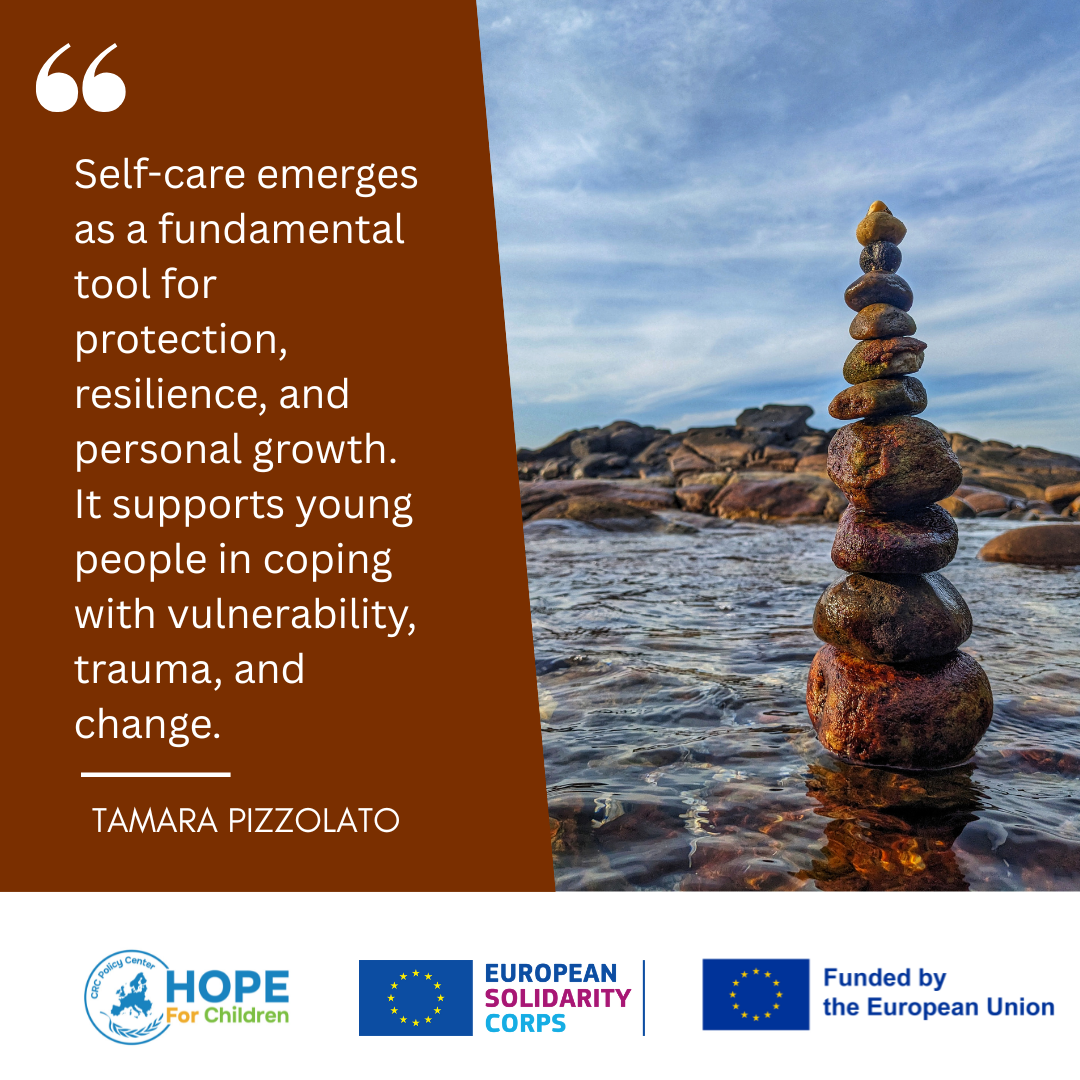
In programs designed for Unaccompanied Minors, self-care emerges as a fundamental tool for protection, resilience, and personal growth. It supports young people in coping with vulnerability, trauma, and change, and represents a central theme in educational, social, and psychological work. These minors often experience significant trauma, migratory stress, and emotional fragility, including traumatic family separations, violence, loss, dangerous journeys, and legal and cultural uncertainty. As a result, they carry a psychological and emotional burden that is often extremely difficult to manage at such a young age.
In addition to past experiences, there are also legal constraints and the rigid age limit of 18 marking the end of reception pathways, which frequently fails to take into account individual characteristics, levels of maturity, and specific support needs. This rigidity can lead to abandonment, increased vulnerability, and a higher risk of exploitation. Consequently, there is an urgent need to design personalized pathways that place young people’s social development at the center, value their uniqueness, and ensure an approach based on attentive listening, mutual understanding, and relational care.
It is therefore essential to place the well-being of minors at the core even in collective contexts such as shelters, recognizing and valuing diverse skills, interests, and individual characteristics. Practices should be empowering and relational, fostering authentic encounters with others and counteracting stereotypes and oversimplifications. It is crucial to begin with more concrete and routinized forms of self-care, while also leaving space for reflective self-care, always tailored to the child’s age and guided by professionals capable of welcoming, valuing, and containing the experiences that emerge.
Conclusion
In conclusion, self-care is not limited to simple attention to oneself but represents a complex and multidimensional practice encompassing social, emotional, spiritual, and physical well-being. In the case of Unaccompanied Minors, self-care helps manage trauma, promotes integration, and supports personal growth. Educators and professionals have the responsibility to help children understand the importance of self-care in achieving their sense of well-being, to create safe, attentive, and relational environments that value each young person’s uniqueness, foster autonomy, and support the development of a sense of self, while also caring for themselves as professionals. Adopting a care-centered perspective allows practitioners to address individual and cultural complexities, offer personalized pathways that respect the dignity of minors, and transform the educational experience into a concrete tool for empowerment, resilience, and inclusion.
Sources
Iori, M. (2025). Etica della cura e cura di sé: Prospettive per la ricerca e l’accoglienza di minori stranieri non accompagnati. Formazione & insegnamento, 22(1)
Sà, R. L. (2023). Dall’Etica della cura all’Ospitalità incondizionata. Per una filosofia della migrazione. Pedagogia più didattica, 9(1), 4–21
Schippers, M. (2021) Children on the move: A guide to working with unaccompanied children in Europe. Utrecht: European Guardianship Network.