











1. Introduction
The internet has become an integral part of children’s lives, offering a wide range of opportunities for learning, exploring, informing, and interacting with others. According to UNICEF, there is clear evidence that children and young people are spending more time in the digital world than ever before, making them more digitally connected. However, this increased online presence also exposes children to numerous risks, including cyberbullying, misleading or manipulative marketing practices, sexual abuse and exploitation as well. The scale of these problems is alarming, with a significant proportion of children experiencing online harm every month. This picture becomes even more troubling when considering the added risks associated with artificial intelligence (AI) which, if not properly designed, used, and monitored, can intensify existing threats or introduce entirely new forms of harm for children, without respecting the Article 19 of the United Nations Convention on the Rights of the Child 1989 (UNCRC).
2. Sexual and Economic Exploitation
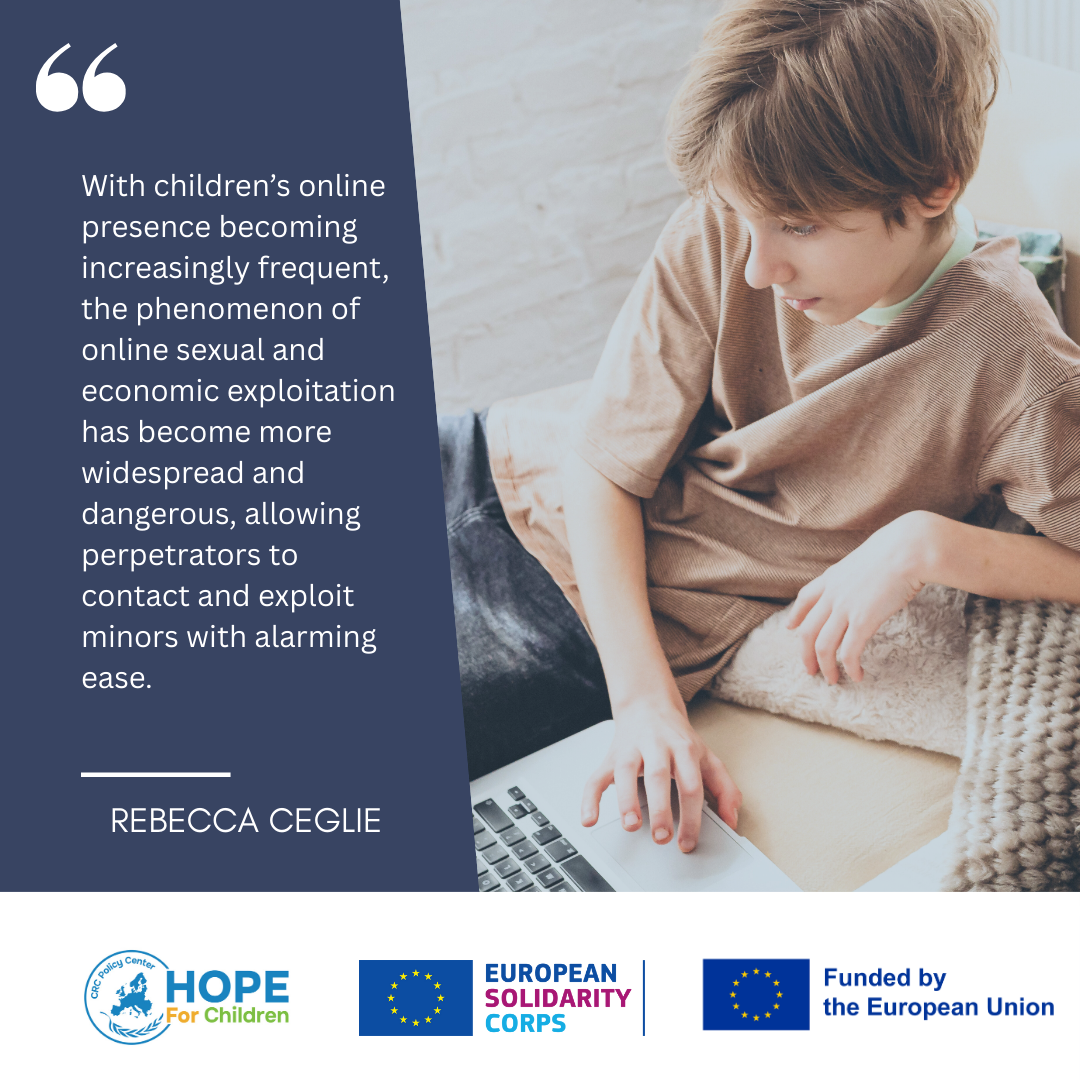
With children’s online presence becoming increasingly frequent, the phenomenon related to online sexual and economic exploitation has become more widespread and dangerous, allowing perpetrators to contact and exploit minors with alarming ease. In this line, the limited perception of children of what constitutes abuse elevates their risk of victimization, and they may be unaware of perpetrators’ motives, thus more susceptible to manipulation and coercion.
A 2021 WeProtect survey on childhood experiences of 2,000 18-year-olds across Europe, found that over half of young people had experienced some form of sexual harm online in their childhood, with girls representing a disproportionately high percentage of children targeted by online offenders. According to the 2021 survey, almost four in five girls (79%) experienced at least one sexual harm during childhood compared with 57% of boys. While ethnic or racial minority, LGBQ+, transgender or non-binary have accounted for the group most likely to experience these online sexual harms during childhood. Building trust and manipulating them into sharing sexually explicit images or videos, online offenders can direct the exploitation of children who may be thousands of miles away.
Furthermore, the exposure of children and young people to harmful material or their coercion into providing sexual images of themselves represents another serious issue in the online environment considering the growth of the ‘sextortion‘, which also increases the risk of cyber-bullying. According to Europol findings, the production of self-generated material is in many cases a consequence of sextortion, where persons using fake accounts approaches minors on digital platforms, coerces them into sending explicit photos or videos, and threatens to make these public. According to an annual report by the Internet Watch Foundation (IWF), the number of child sexual abuse images hosted in European Union member states is increasing. Indeed, the latest report revealed that in 2024, 62% of all webpages containing Child Sexual Abuse Material (CSAM) detected by IWF were traced to EU countries. Most of the children displayed were aged between 7 and 10, followed by those between 11 and 13. Moreover, young girls were also nearly four times more displayed compared to boys.
Similarly, the economic exploitation of minors is increasingly emerging through online channels as well, where social media, messaging platforms, and fake job advertisements allow offenders to contact children and adolescents with ease. According to the EC 2025 Fifth progress report, digitalization has led to a worrying increase in cases of child prostitution leading to trafficking because of the active presence of children on social networks and gaming sites, which attract the attention of traffickers. In this context, children who come from fragile social and family backgrounds often face heightened vulnerability and are exposed to forced criminality, forced begging, forced marriage, and labor exploitation as well, facing both short-term and long-term physical, mental, and emotional difficulties, along with other serious developmental challenges. These children, mostly living in residential or institutional care, often struggle with low self-esteem and psychological disorders, which can sometimes lead to substance abuse. In this context, unaccompanied minors are especially vulnerable due to the absence of family support, urgent financial pressures, language barriers, and their heavy dependence on mobile phones as their main tool for communication make them particularly easy targets for exploitation. Along this line, these children are usually exploited in services within the agriculture, construction, and cleaning sectors.
All this clearly shows that the child trafficking is a rapidly evolving and multi-faceted form of trafficking in human beings, which undermine the human rights of children promoted on the Convention on the Rights of the Child (CRC). Relevant insights show that in 2021–2022, 81% of identified child victims were EU citizens, and 88% were exploited within their own Member State.
3. Cyprus Insights
According to the EU Kids Online of 2014, the majority of children in Cyprus used the internet mainly for gaming (86%), watching video content (84%), school-related activities (79%), and downloading music or films (58%). However, their levels of digital literacy and online safety skills remained relatively low, particularly when it came to adjusting privacy or filter settings, evaluating the reliability of online information, blocking unwanted advertisements or spam, and accessing guidance on safe internet use. The 2014 report confirmed that 18% of 11–16-year-olds say they communicate through a social networking website with people they met online who are not part of their offline social networks. In addition, 33% of Cypriot children had contact with a person they met only on the internet when playing online games. It also affirmed that many Cypriot children who use the internet (73%) have a social networking profile, and they accept invitations from strangers, displaying abundant information about themselves. Moreover, one quarter (24%) of Cypriot 9–16-year-olds say that they have seen sexual images in the past 12 months, whether online or offline and among them, 30% of the parents of the children who had seen images say their child has not seen them and 24% say they don’t know if they have seen them.
Nowadays, the alarm raised by the Cypriot police over the rising number of cases involving child sexual abuse material is still far from reassuring. In the first half of 2025 alone, authorities recorded 100 incidents, adding to an already worrying trend: 208 cases were documented in 2024, 203 in 2023, and more than 200 every year since 2021. This pattern is consistent with broader data on sexual violence against children. As a result, Hope for Children CRC Policy Centre reported 469 cases of child sexual abuse in 2023 and 330 more by October 2024. While the Cypriot Commissioner for Children’s Rights, Despina Michaelidou, further underlined the global dimension of the issue, noting that an estimated 785,000 reports of potential online child abuse were made worldwide in 2023.
4. European and National Actions
In order to protect and help children online, the EU has adopted various declarations and strategies “to make safe and informed choices and express their creativity in the digital environment” during the last few years. The European declaration on digital rights and principles 2022 seeks to promote positive experiences in an age-appropriate and safe digital environment that protects children against harmful and illegal content, exploitation, manipulation and abuse online. While the Better Internet for Kids (BIK+) strategy published in 2022 by the European Commission aims to create a safe, diverse, inclusive and non-discriminatory digital space in which children can thrive and fulfil their potential, built around safe digital experience, digital empowerment and active participation.
Over the years, the EU has adopted numerous regulations, as well as directives that contain articles aimed at protecting children online. Among them, the Digital Services Act (DSA) represents one of the most important EU digital regulations that protects citizens, including minors, from online harm; the General Data Protection Regulation (GDPR) stabilises transparent and clear information and communication with children relating to data processing; the Audiovisual Media Services Directive protects minors from harmful content, including advertising, by requiring EU Member States to ensure that video-sharing and video-on-demand platforms take measures to safeguard children’s physical, mental, and moral development.
Relating to this, some countries have introduced or proposed laws limiting parents’ ability to share children’s information online. At the same time, schools, parents, health professionals, public authorities, and NGOs are increasingly raising awareness about the risks of digital technologies and promoting good practices.
Similarly, Cyprus, in line with European regulations and directives, continues to actively safeguard children’s rights in the online environment. Most recently, the country joined five other European leaders in calling for the introduction of a common “digital age of adulthood” across the European Union, with the aim of improving online safety and preventing sexual and economic exploitation. Furthermore, the Cyprus Safer Internet Centre Helpline 1480 plays a crucial role in assistance, guidance and mechanisms for reporting illegal content, grooming, child pornography, and other forms of online abuse, offering vital support to children, caregivers and professionals. Accordingly, also Hope for Children HFC Policy Center supports children providing a National Helpline 1466 and a European Helpline for Children & Adolescents 116 111.
5. Conclusion
While these European and national legal instruments are essential, their effective enforcement remains challenging, as it requires significant resources, coordination among EU institutions, national authorities, children’s rights organizations, and experts, as well as adaptation to the rapid evolution of technology. Much work remains to ensure that children are fully shielded from the various harms associated with the online environment while still being able to benefit from its opportunities. In this sense, particular attention should be provided to the risks mentioned related to grooming, sextortion, gender discrimination, and exposure to inappropriate content, ensuring a safer, empowering, and well-regulated digital environment for all children.