










Introduction
In an increasingly digital world, the safety of children navigating online using new digital tools and sharing platforms appears to be constantly threatened by serious risks that can lead them to become victims of online aggression, exploitation, or abuse. Among these are risks created by the parents themselves, who are often unaware of the significant exposure they are causing for their children both inside and outside the digital world, incrementing a phenomenon known as sharenting.
The Risks of Sharenting
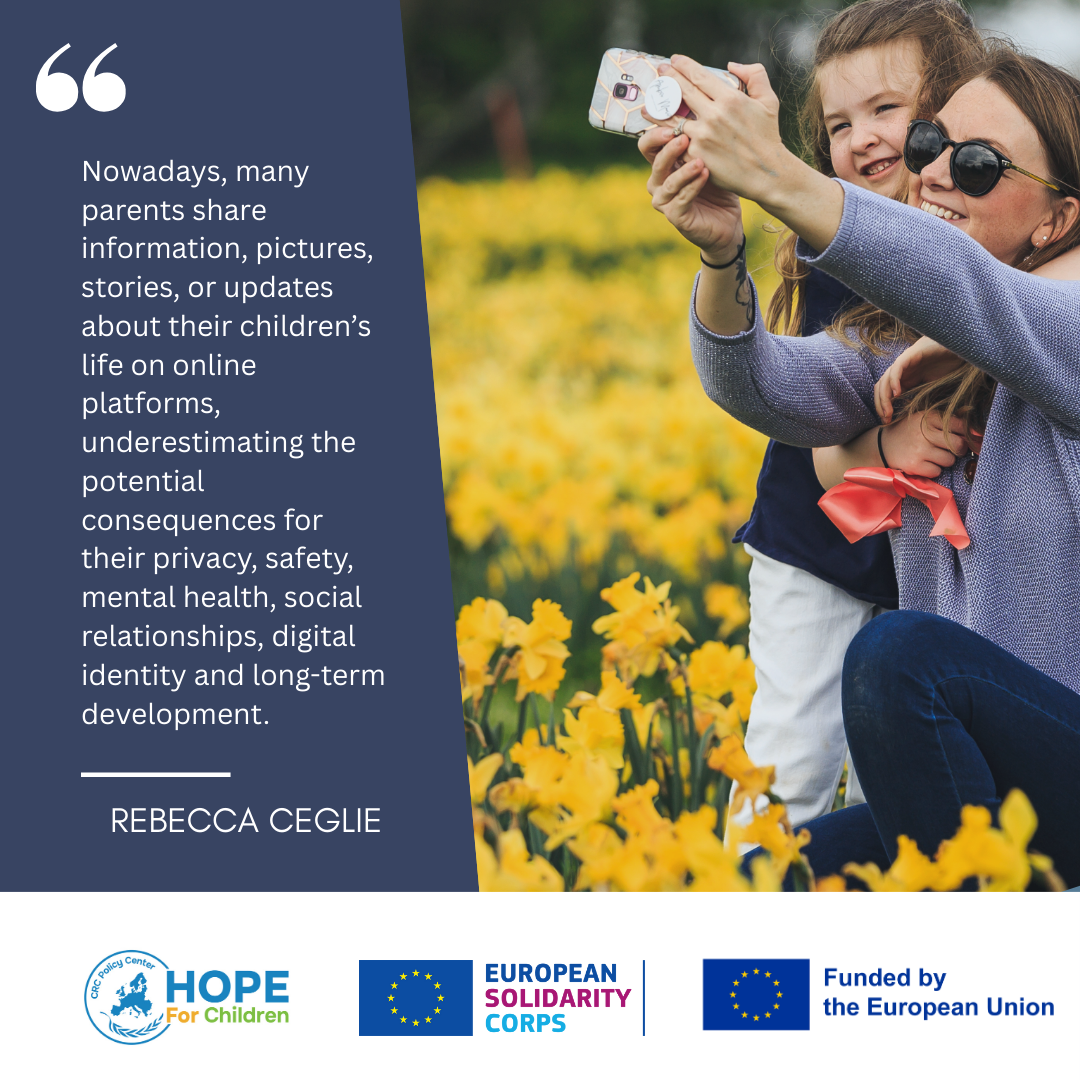
Nowadays, many parents share information, pictures, stories, or updates about their children’s lives on online platforms, often underestimating the potential consequences for their privacy, safety, mental health, social relationships, digital identity, and long-term development. This phenomenon is commonly referred to as “sharenting”, a term combining the words sharing and parenting. It describes the increasingly common practice of parents posting photos, videos, or other personal information about their children on social media, often starting in the first months of life.
In this regard, a recent European study report that every year parents share an average of about 300 photos and countless sensitive data about their children online, most of them on Facebook (54%), Instagram (16%), and Twitter (12%). Specifically, a pilot study conducted in Italy found that 65.7% of parents surveyed said they had posted images of their children on social media. Similarly, another study conducted in Spain reports that 83% of parents have posted photos or videos of their children online.
While these shares can create moments of joy and connection with friends and family, they also raise important issues related to children’s rights, particularly privacy, dignity, and online safety. In this line, UNICEF affirmed that sharing information and images of children online could not only compromise the relationship between parents and children in terms of consent and permission but also represent a risk in terms of the use of images for pornographic or improper purposes by third parties.
Firstly, sharing content without involving children deprives them of the opportunity to learn about consent and privacy and may result in a violation of personal boundaries. In this regard, a 2021 survey of 1,000 parents conducted in the in the United States found that more than 75% of parents post information about their children online. Fewer than one quarter of parents reported always seeking their children’s permission before sharing content about them on social media, while approximately one third stated that they never ask for their permission.
Secondly, children who are portrayed online may become targets for adults with malicious intentions. In some countries, data brokers also collect information shared by parents to create digital profiles of children, which can be used to predict behaviors or even future health conditions. Moreover, technological advances such as artificial intelligence have led to an increase in fake or manipulated images, which may be misused, widely disseminated, or go viral, potentially portraying children in a harmful or degrading manner. In this context, the National Center for Missing & Exploited Children (NCMEC) reported receiving 4,700 reports in 2023 alone related to Child Sexual Abuse Material (CSAM) or sexually exploitative content that involved GAI technology (GAI CSAM).
Finally, digital child labour is emerging as a concern in this delicate context, exposing children in ways that generate economic benefits for adults, potentially leading to exploitation and pressure to perform content creation. UNICEF stressed the emerging concern of “digital child labour”, including roles as social media influencers or participation in eSports, which can lead to economic exploitation if not controlled.
In this line, posting children online may expose them to serious long-term risks, including identity theft, cyberbullying, and even exploitation through AI-generated content, as well as trauma on victims and their families.
Children’s Right to Privacy and Protection From all Violence
Even seemingly harmless content can remain online indefinitely, creating digital traces that are difficult to erase in the future. This can undermine children’s right to be protected from the unauthorised disclosure of personal information, as established by the Convention on the Rights of the Child (UNCRC).
Article 16 of the UNCRC clearly sets out the obligation to respect children’s right to privacy, stating that no child should be subjected to “unlawful interference with their privacy, nor to unlawful attacks on their honour or reputation”. In this context, parents often appear to overestimate the effectiveness of privacy settings while underestimating the risks associated with sharing content online.
Similarly, Article 19 of UNCRC guarantees protection from all forms of violence and abuse, including those that occur online. In this context, sharenting can indirectly increase children’s exposure to harmful content or predatory individuals, potentially causing long-term psychological trauma.
Sharing With Care
While sharing personal information is an individual choice, sharing information about children carries a responsibility to respect their privacy. European frameworks, such as the EU Charter of Fundamental Rights and the European Declaration on Digital Rights and Principles, underscores children’s right to privacy, protection, and respect in the digital environment. Similarly, the Convention on the Rights of the Child emphasises the fundamental right to safeguard children everywhere, including online.
In light of this, families who choose to share content about their children online should carefully consider how much information they are disclosing, including locations or other identifiable details, and whether the content could be embarrassing, harmful, or risky for the child now or in the future. Parents should also evaluate their audience, taking into account privacy settings, who has access to their profiles, and how well they know their followers.
As stated by UNICEF, parents often view their children as an extension of their own identity; however, children are individuals with their own rights, feelings, and dignity. Therefore, it is crucial for parents to seek their children’s consent, limit the sharing of sensitive information, and use online platforms responsibly to avoid negatively impacting their children’s self-esteem, social relationships, or future opportunities.