










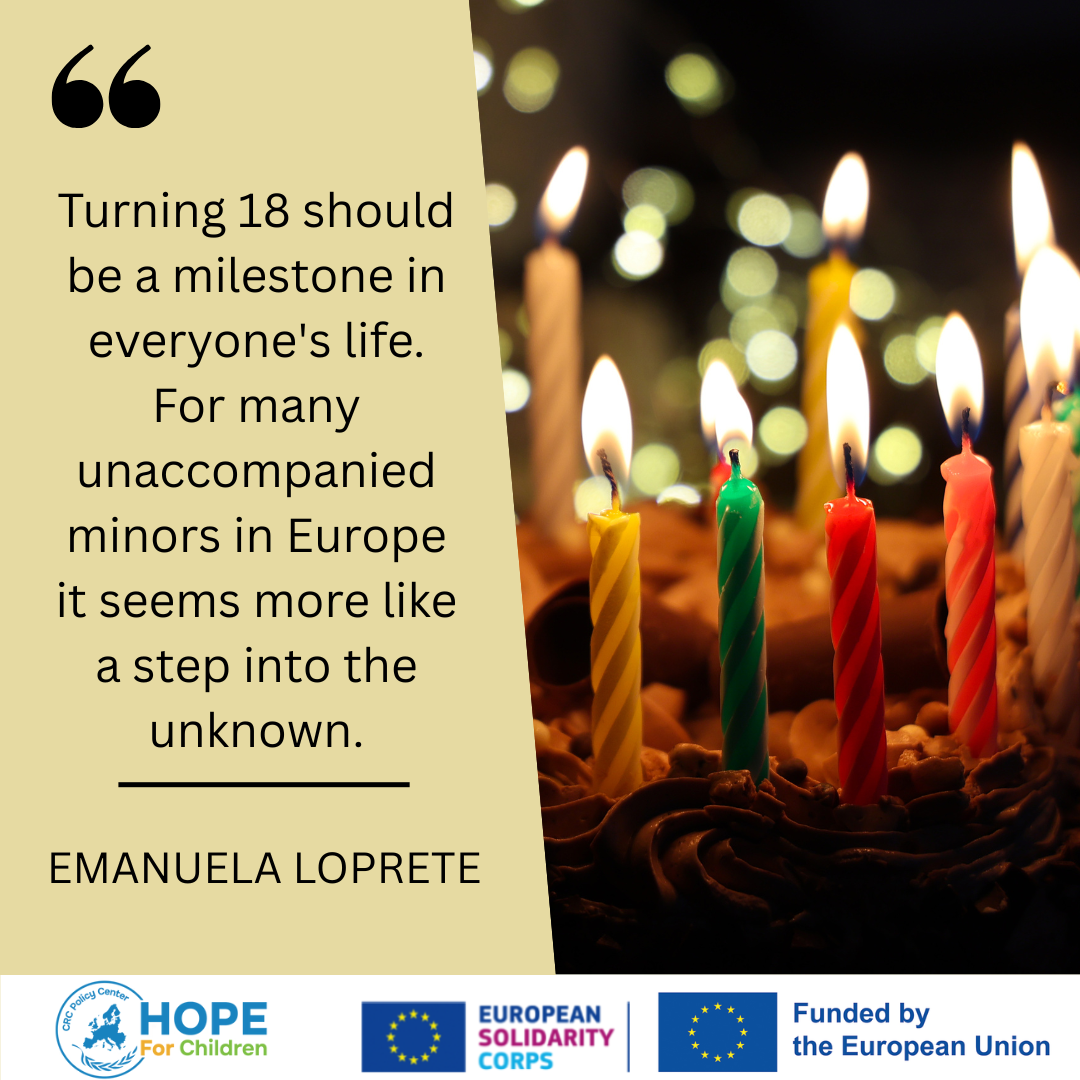
Turning 18 should be a milestone in everyone’s life: it symbolizes the transition to adulthood, greater independence, and the opportunity to choose one’s own future.
Instead, for many unaccompanied minors in Europe, reaching the age of majority seems more like a step into the unknown: the protections offered to minors cease, while their legal status and reception system remain fragile and uncertain.
The idea that their needs change overnight is unrealistic and is not supported by research on the subject.
What really changes when turning 18
In Europe, the transition to adulthood for unaccompanied minors is marked by considerable difficulties, reflecting the lack of a coordinated approach among Member States. Migration and welfare policies for young people vary greatly from one country to another, leading to structural inequalities in opportunities for integration and building an independent life.
In many national contexts, turning 18 represents a critical threshold: the protection guaranteed during childhood is interrupted from one day to the next and young people are often forced to leave reception facilities, sometimes with minimal notice, without a gradual and structured process. As the European Migration Network points out, this transition can happen overnight, forcing these individuals to enter the adult reception system, where attention to individual vulnerability is usually more limited, or, in the absence of available solutions, to face situations of housing insecurity.
In many European countries, specific protection measures for unaccompanied minors, such as dedicated accommodation, legal guardianship, social services support, and education and training programs, are deeply linked to their status as minors. Once they reach the age of majority, these young people are transferred to systems designed for adult asylum seekers and migrants, where assistance is often standardized and less focused on personal history, trauma, and individual needs. The main problem is the discrepancy between actual vulnerability and the administrative definition of “adult”, which automatically comes into effect at the age of 18.
Many minors arrive in Europe having experienced violence, exploitation, and long migratory journeys marked by traumatic experiences. They often start school or therapy late, have an interrupted education, and extremely limited social networks. Reaching the age of majority does not erase this type of vulnerability but, on the contrary, coincides with an increase in responsibilities, just when protective measures are reduced.
In this context, it has become essential to consider the effects that this discontinuity has on mental health, social stability, and future prospects. Integration should be viewed as a process that requires time, ongoing support, and structural conditions. Reports by the Council of Europe, PICUM, and Save the Children highlight how unguided exit from the protection system exposes these young people to a vicious cycle of housing insecurity, informal work, and, in some cases, legal irregularity.
In this context, turning 18 becomes a paradox: while from a legal point of view it represents the entry into autonomy, in practice it often entails the loss of access to the services that had guaranteed protection and stability. For this reason, there is a strong need to invest in early and structured preparation for the transition, capable of transforming the passage to adulthood from a “jump into the unknown” to a gradual process.
A concrete working model: the transition model of the Netherlands
The Netherlands has one of the most structured systems in Europe for supporting unaccompanied minors in their transition to adulthood. Thanks to a national program that extends support until the age of 21, there is no interruption in assistance when they turn 18.
At the heart of this model is early and coordinated planning, which starts personalized paths to independence at age 16 through a “Life Plan”: an individual project that integrates administrative, educational, psychosocial, and housing aspects. The transition to the second phase of life is not left to chance: each young person has a personalized plan that includes semi-independent housing solutions with expert supervision, vouchers for professional training, simulations of independent living practices (budget management, rental contracts, bills, etc.), and the assignment of a personal mentor for at least three years once they reach the age of majority. This person may be an educator or a volunteer and offers not only bureaucratic support, but also career guidance and psychological support, helping young people to deal with past traumas.
Reported outcomes indicate that 70% of unaccompanied minors in the Netherlands find stable employment within two years, with a 65% reduction in homelessness and a 55% completion rate for studies (compared to 30% in the EU).
This model demonstrates that investing in practical preparation and supportive relationships transforms the transition to adulthood from a critical moment into a real opportunity for autonomy, reducing the social costs of marginalization and promoting the development of active citizens who are integrated into society.
The situation in Cyprus
The Cypriot context is an example of the structural fragility that characterizes the transition to adulthood in countries on Europe’s borders. In recent years, Cyprus has seen an increase in the arrival of unaccompanied minors, mostly adolescents between the ages of 15 and 17, which has caused significant pressure on a reception system that is still focused on emergency solutions rather than long-term pathways to independence.
Upon reaching the age of 18, many young people have to leave the facilities for minors or semi-independent living programs, transitioning to the adult system or, in some cases, to precarious housing conditions, with a “gap” in protection that reflects critical issues already observed at the European level.
In recent years, semi-independent living programs for 16- to 18-year-olds have been developed, managed by social services, international organizations such as IOM, and NGOs such as Hope For Children, with the explicit aim of facilitating the transition to adulthood and integration into Cypriot society. However, these initiatives remain limited and are not yet part of a comprehensive legislative framework for after-care, meaning that the continuity of support beyond the age of 18 depends largely on specific projects and the involvement of the third sector rather than on a permanently guaranteed right.
Conclusion
Turning 18 should mark the beginning of independence, not the end of protection. For many unaccompanied minors in Europe, however, coming of age still too often coincides with a loss of protection, legal uncertainty, and a significant increase in vulnerability. The evidence analyzed clearly shows that chronological age alone is not a realistic indicator of the ability to deal with independent living, especially for young people who have experienced trauma and instability.
European research and good practices indicate that indefinite protection is not necessary, but rather a planned and gradual transition. Where states invest in early preparation, individualized transition plans, legal regularization pathways, and relational support that continues beyond the age of 18, the results are significantly better: homelessness decreases, mental health improves, and opportunities for social and labor market inclusion increase.
A comparison of different national approaches shows that this is ultimately a political choice, not an inevitable fate. Ensuring a safe transition to adulthood for unaccompanied minors is not only a matter of assistance or solidarity, but also of consistency with European values and long-term social sustainability. If Europe truly wants to protect children, it must ensure that this protection does not end just when it is most needed.
Links
- Unaccompanied and Separated Asylum-Seeking and Refugee Children Turning Eighteen: What to celebrate? – Save the Children’s Resource Centre
- Turning-18-and-undocumented_EN.pdf
- nascosti-piena-vista-2024.pdf
- Supporting young refugees in transition to adulthood – Recommendation CM/Rec(2019)4
- BAMF – Bundesamt für Migration und Flüchtlinge – EMN Informs – EMN Inform: Transition of unaccompanied minors to adulthood
- Navigating-Irregularity_EN.pdf