










Background
Article 34 of the UN Convention on the Rights of the Child states that states must protect children from all forms of sexual abuse and exploitation. This includes Child Sexual Abuse Material (CSAM), more commonly known as “child pornography”. While it is hard to get an exact number of victims of CSAM, there were more than 20.5 million reports of suspected online CSAM in 2024. This highlights the size of the issue, especially since this number only included reported CSAM.
A report by ECPAT gives insight into the demographics of who is victimised in CSAM. ECPAT is an international organisation that coordinates research, advocacy, and action to end the sexual exploitation of children. “Hope For Children” CRC Policy Center is one of the 141 members of ECPAT International. The report shows that around two thirds of victims of CSAM are girls and one third are boys, and in some cases boys and girls are depicted in material together. There is also a variety in the ages of children appearing in CSAM. Around a quarter (25,4%) of victims is pubescent (usually this means older than 13), more than half is prepubescent (56,2% are prepubescents, meaning they appear younger than 12 or 13 years old, and 4,3% are infants or toddlers), the rest of CSAM includes children of multiple ages. When the victims depicted were very young or boys, the abuse was likely to be more severe.
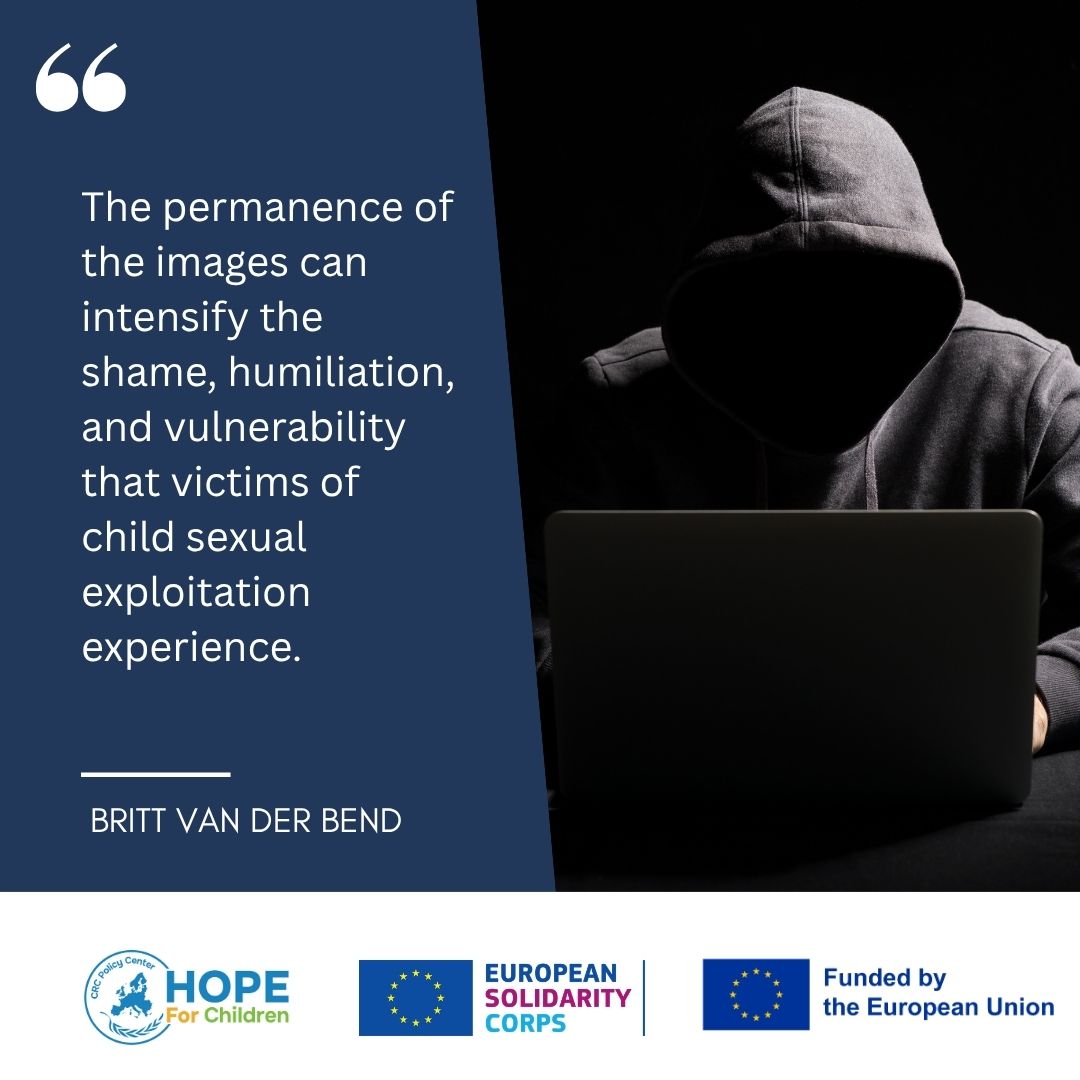
Child sexual exploitation is known to have a long-lasting impact on the mental health and wellbeing of the children involved. As a result, they can suffer from anxiety, depression and eating disorders. They often blame themselves and experience low self-esteem. Further research has shown that CSAM can have additional negative psychological effects on its’ victims due to the possibility of the images being shared online. The permanence of the images can intensify the shame, humiliation, and vulnerability that victims of child sexual exploitation experience.
This article provides information on how reporting CSAM works. Then, it explains the insights gained from the reported CSAM. Afterwards it dives into the role of Artificial Intelligence (AI) and the harm AI-generated CSAM causes. Finally, some action points are highlighted.
Reporting CSAM
There are multiple ways to report CSAM. These include reports by the victims to the relevant national authorities, as well as reports made by individuals who have accidentally encountered such material online. These websites show that reports can be made directly to the police, but also to non-governmental organisations (NGOs) fighting CSAM. Most countries have their own NGOs, the Internet Watch Foundation (IWF) will be used as an example of one of those NGOs to illustrate the work that is done after reporting content.
After content is reported, the IWF assesses whether the material breaks the law and includes child sexual abuse. IWF is an organisation from the United Kingdom, there CSAM is assessed and divided into three different categories. Category A is the most severe abuse and includes images involving penetrative sexual activity, sexual activity with an animal or sadism. This is followed by category B with includes images involving non-penetrative sexual activity. Lastly, category C includes other indecent images that do not fall in category A or B. After the content is assessed and determined to be CSAM, IWF work to get the content removed from the internet. This often requires international cooperation, as the content can be located anywhere.
Insights from reporting
Each year the IWF makes an annual report on the CSAM reports they received that year. In 2025, they assessed 451.210 reports of which 311.610 were confirmed as or linked to child sexual abuse material. They assessed the content of the images and tracked not only the severity of the abuse, but a variety of other aspects as well (i.e. age, gender, AI-generation and hosting platforms).
First, IWF found that in 2025 77% of non-AI-generated child sexual abuse images depicted girls, while 97% of AI-generated child sexual abuse images showed girls. This illustrates the gendered nature of CSAM and how the proportions of girls and boys changes depending on whether the images were AI-generated or not.
Second, the report found that among older teenagers, a third of the 56.179 child sexual abuse images were “self-generated”. This means that the child or children were seen alone rather than with a perpetrator physically present at the time of recording. While the child/children were shown alone, this does not mean that there were no perpetrators involved in the making of the video. They could have been present digitally or the children might not have been aware they were being watched.
The report does not solely include data on individual instances of CSAM, it also tracks the URLs of the content. IWF found that from the reports they assessed the top hosting countries (by share of URLs and unique domains) were: the US, the Netherlands, Bulgaria and Russia. Other research has found similar results regarding the Netherlands as host country for CSAM. This research found that the Netherlands hosts almost a third of CSAM globally and over 60% of CSAM in Western Europe. Both the Netherlands’ position as a global data hub and the legal framework could be factors contributing to the CSAM problem in the Netherlands.
Lastly, the report noted the increase in AI-generated videos and their realism over the past years. Of the AI-generated videos, 65% of those videos were classified as category A content compared to the 43% of videos with real children. This highlights how developments in AI contribute to the creation of CSAM.
Developments in Artificial Intelligence
Recently UNICEF published a brief that explored the threat AI poses to the protection of children from sexual exploitation and abuse. Fast developments in AI, have led to more realistic AI-generated content. This realism, combined with the easy accessibility of AI, results in large amounts of photo-realistic AI-generated CSAM. While at first glance it might not seem like real children are involved, there is still serious harm done by AI-generated CSAM. First, there are consequences on an individual level, when images of children are manipulated to into explicit images. In some countries, this is so prevalent that 1 in 25 children reported that they too had their images manipulated by AI. Second, children can be victimised when the AI-image resembles them. Third, on a societal level, increased content that is more easily accessible contributes to the normalisation of CSAM and might lead to increased victimisation. Lastly, organisations trying to protect victims might not be able to tell realistic AI imagery apart from imagery of children who are in acute danger of further abuse. Thus, it led to the wasting of resources that could be used to protect more children.
A recent example that got a lot of media attention is Grok – the integrated AI-chatbot on X (formerly twitter). People were able to ask the chatbot to undress individuals in photos, which led to a lot of sexualised images. Center for Countering Digital Hate (CCDH) estimates that over the 11 days that Grok was active, over 3 million sexualised images were created. Of those images 23.000 are estimated to be CSAM. After 11 days Grok was restricted to paid users, with further limitations on the use of the chatbot being implemented another 5 days later. What happened brought a lot of attention to CSAM, specifically the role AI plays. It underlined the role of technological companies in fighting CSAM.
Action points
A 2020 summary paper by ECPAT outlines five action points for fighting online child sexual exploitation. First, they highlight the necessity of a comprehensive legal framework to improve the protection of children. Internationally, CSAM legislation should become standardised in more countries, because due to CSAM existing online, investigations often cross into multiple jurisdictions. Within countries that already have relatively well-established CSAM legislation (for example: France, Australia, India, Columbia, etc.), there will need to be continuous developments as the technology evolves. Second, they underline the importance of international cooperation to ensure fast and effective responses to CSAM. Related to the last point, the international nature of CSAM requires effective collaboration between countries in order to remove CSAM and prosecute guilty parties. Third, ECPAT emphasizes the need for commitment from the private sector to help fight CSAM. These companies could help find innovative ways to fight CSAM. Other possibilities include better technical restrictions for their AI-chatbots to prevent misuse as well as making it easier to remove CSAM from their social media sites. Fourth, they focus on the need for youth to be educated on online threats. Education could be beneficial in reducing the amount of “self-generated” CSAM. Additionally, education could reduce the risk of children getting caught up in situations leading to CSAM as well as normalising open conversation about these issues. Lastly, ECPAT directs attention to victims’ support and access to justice. The permanent nature of CSAM requires specialised support. It also makes it harder for victims of CSAM to access the justice system.
Conclusion
Every year, many children of different ages fall victim to online sexual exploitation resulting on child sexual abuse material. When people come across CSAM, they can report it to the authorities and to NGOs that work towards taking the content down. Reports have shown an increase in AI-generated CSAM. Developments in AI show how CSAM is evolving, highlighting the necessity of continuous improvement in legislation, cooperation and education to further prevent and fight online child sexual exploitation.