









Service Learning (SL) represents today an educational proposal capable of combining learning with concrete engagement in the community, going well beyond traditional teaching methodologies. It is a pedagogical approach that encourages rethinking content and methods with the aim of improving and transforming reality. It unites Learning, understood as th process of acquiring knowledge, with Service, understood as a constructive engagement with the comunity. It is therefore an integrated educational model in which students become active protagonists, developing skills, civic values, and responsible behaviors through concrete service experiences.
Service Learning is based on three main pillars: the enhancement of learning connected to the curriculum and the knowledge to be acquired; the promotion of solidarity-based activities for the benefit of a specific community; and the active participation of students, teachers, and citizens. It is not simple volunteering or an occasional activity, nor an internship or work placement. Rather, SL implies that the knowledge acquired in the classroom is tested in real contexts by addressing authentic community problems. Adopting this approach in schools allows students not only to learn content, but also to apply it meaningfully within their local context, contributing to the improvement of the social reality in which they live.
Transversal learning outcomes of Service Learning
Service Learning is characterized by a pedagogical approach that promotes five fundamental pillars, derived from international experience and currently being defined also by UNESCO:
- Learning to learn: students improve their motivation for learning through the practical experimentation of theoretical knowledge, generating new learning by applying it in real contexts.
- Learning to do: service activities develop operational skills for active citizenship, such as teamwork, problem solving, responsibility, and effective communication.
- Learning to be: the transversal reflection between theoretical knowledge and practice fosters the development of prosocial attitudes, active listening, and the appreciation of both individual and collective dimensions.
- Learning to live together: SL projects encourage cooperation with people, organizations, and different social realities, promoting active participation, the construction of supportive communities, and processes of empathy.
- Learning to become: students design real interventions for the benefit of the community, identifying concrete problems to address and developing planning skills, responsibility, civic awareness, and increased self-esteem.
These pillars fit perfectly within the framework of the 2030 Agenda for Sustainable Development, which emphasizes, in Goal 4, that quality education is a prerequisite for the development of global citizenship, a culture of sustainable development, and the recognition and appreciation of cultural diversity. Service Learning enables the transfer of skills acquired in the classroom to real-life contexts, promoting responsible and active citizenship.
Didactic and Pedagogical Characteristics of Service Learning
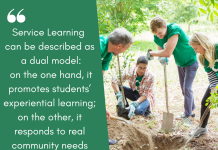
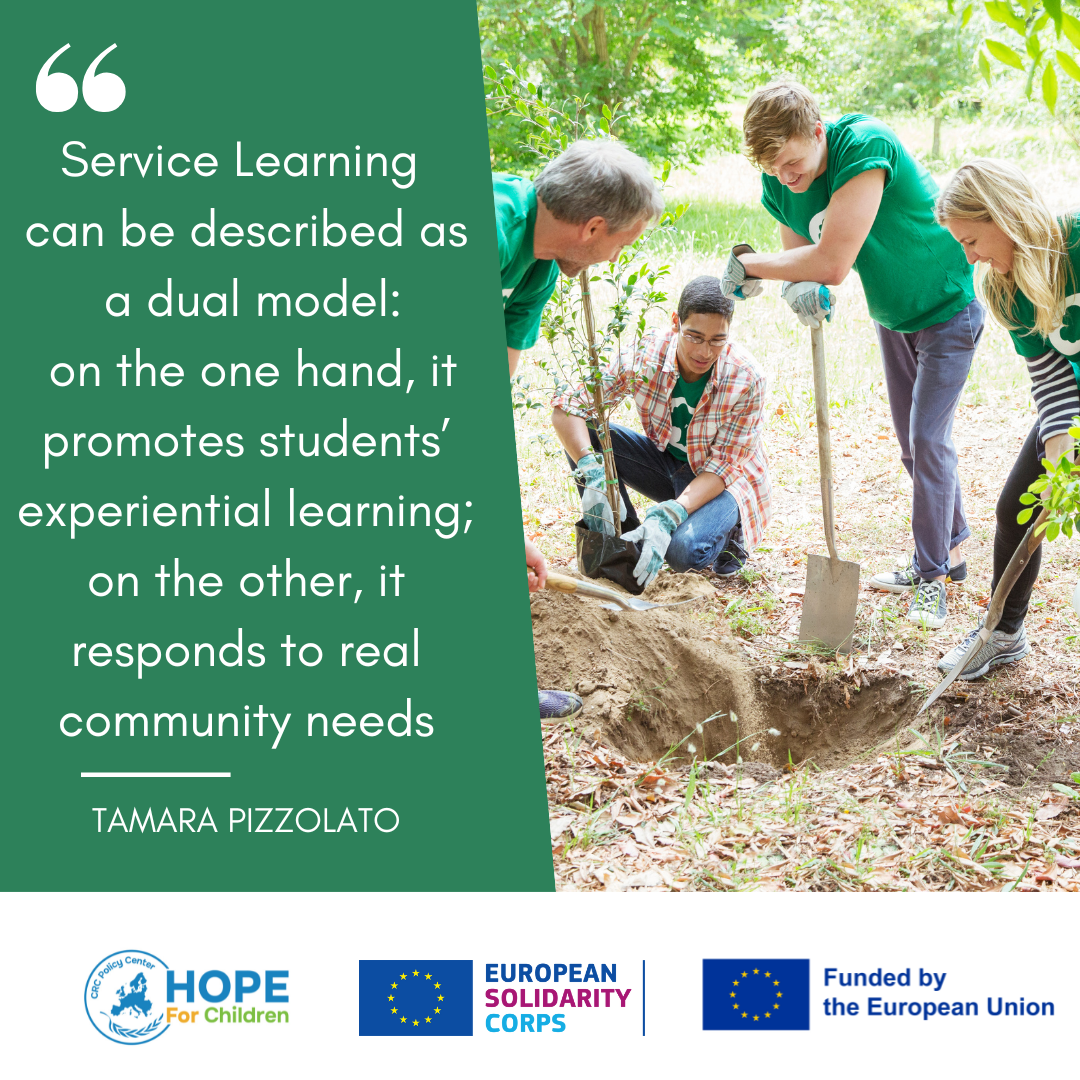
Service Learning can be described as a dual model: on the one hand, it promotes students’ experiential learning; on the other, it responds to real community needs. It is a situated and meaningful pedagogy, based on reflection, practical application of knowledge, and collaboration among different local stakeholders. Students are involved in all phases of the project—from needs assessment to planning, implementation, and evaluation—and develop interdisciplinary skills, a sense of responsibility, and the ability to participate actively.
Among the objectives of Service Learning are the development of knowledge, skills, behaviors, and civic values; increased motivation to study; the reduction of school dropout rates; and the promotion of positive relationships between students and teachers. At the same time, it fosters empathy, willingness to engage in volunteering and cooperation, and allows students to experience concrete solutions to community problems, strengthening their sense of identity and belonging to the local territory—an asset that can also be valuable beyond school time.
Towards a Transformative Pedagogy
Service Learning is therefore not merely a methodology, but a truly transformative pedagogical and didactic approach that directs educational action toward the improvement of social reality. The school becomes a place of collaboration and openness toward the community, developing networks and promoting reciprocity. Activities are integrated into the curriculum and aim at meaningful and participatory learning, capable of connecting theory and practice, knowledge and values, individual action and collective commitment.
In this context, SL is defined as an inclusive approach, as it promotes the integral development of the person, moving beyond a purely cognitive and operational perspective to embrace ethical, social, and civic dimensions. Concrete experience allows students to practice learning to live together, recovering a community-oriented dimension that values participation, solidarity, and the shared construction of values. The goal is to overcome individualism and foster social cohesion through educational practices that make students protagonists of their own learning and of the improvement of the community.
Service Learning Practices in Cyprus
Service Learning is present and practiced in Cyprus, but it is not yet widespread throughout the entire national education system, unlike in in European countries such as Spain, Italy, or Portugal, where it is formally integrated into school curricula. In Cyprus, its implementation is mainly concentrated in specific contexts, particularly within international schools and in innovative, community-oriented educational initiatives.
Academic interest in this methodology is confirmed by the organization of internationally relevant events, such as the International Symposium on Service-Learning hosted by the University of Nicosia. This initiative highlights the existence of an active network of scholars and professionals engaged in critical reflection on the educational and civic value of Service Learning. At the same time, some international schools operating in Cyprus integrate service-learning projects into their educational programs, fostering meaningful connections between disciplinary content and concrete actions that benefit the local community.
A representative example is the American International School in Cyprus (AISC), where students from kindergarten through high school design and implement Service Learning projects addressing real community needs. These initiatives include collaboration with the Hope For Children organization, through which younger students produced and sold organic soap to support refugee shelters, as well as clothing and toy drives for children in need, donations to Makarios Children’s Hospital, and environmental awareness campaigns focused on water conservation and recycling. Such projects illustrate how Service Learning can effectively link curricular learning with social responsibility and civic engagement.
Cyprus also participates in European initiatives and projects, such as those promoted within the Erasmus+ framework, which promote Service Learning as a practice aimed at education for active citizenship and democratic participation. However, despite these positive developments, Service Learning remains largely limited to specific educational contexts and has not yet been fully structured or officially recognized at the national policy level.
Conclusion
In conclusion, Service Learning represents a deeply innovative educational proposal: it places experiential learning, social responsibility, and active participation at the center of the educational process. Through this pedagogy, the school becomes a space for individual and collective growth, where learning is transformed into concrete action beyond the classroom walls and placed at the service of the community. In doing so, it prepares aware, competent, and supportive citizens capable of facing the social and cultural challenges of the contemporary world.
Resources
Cress, C. M., Collier, P. J., & Reitenauer, V. L. (2005). Learning through serving: A student guidebook for service-learning across the disciplines. Stylus Publishing.
MIUR – Ministry of Education, University and Research. (2019). Guidelines for Service Learning in Italian schools. Rome: MIUR.
Roche Olivar, M. (2010). Service-learning: A pedagogical approach for integral formation. Education and Society, 29(2), 45-62.
Tapia, M. (2008). Service-learning and civic engagement in education: A global perspective. International Journal of Educational Development, 28(5), 556-567
UNESCO. (2015). Education 2030: Incheon Declaration and Framework for Action. Paris
https://www.aisc.ac.cy/activities/service-learning-activities/?utm
https://www.unic.ac.cy/call-for-papers-the-8th-international-symposium-on-service-learning-issl
[A1]I broke donwn the original sentence into smaller ones, to improve clarity