











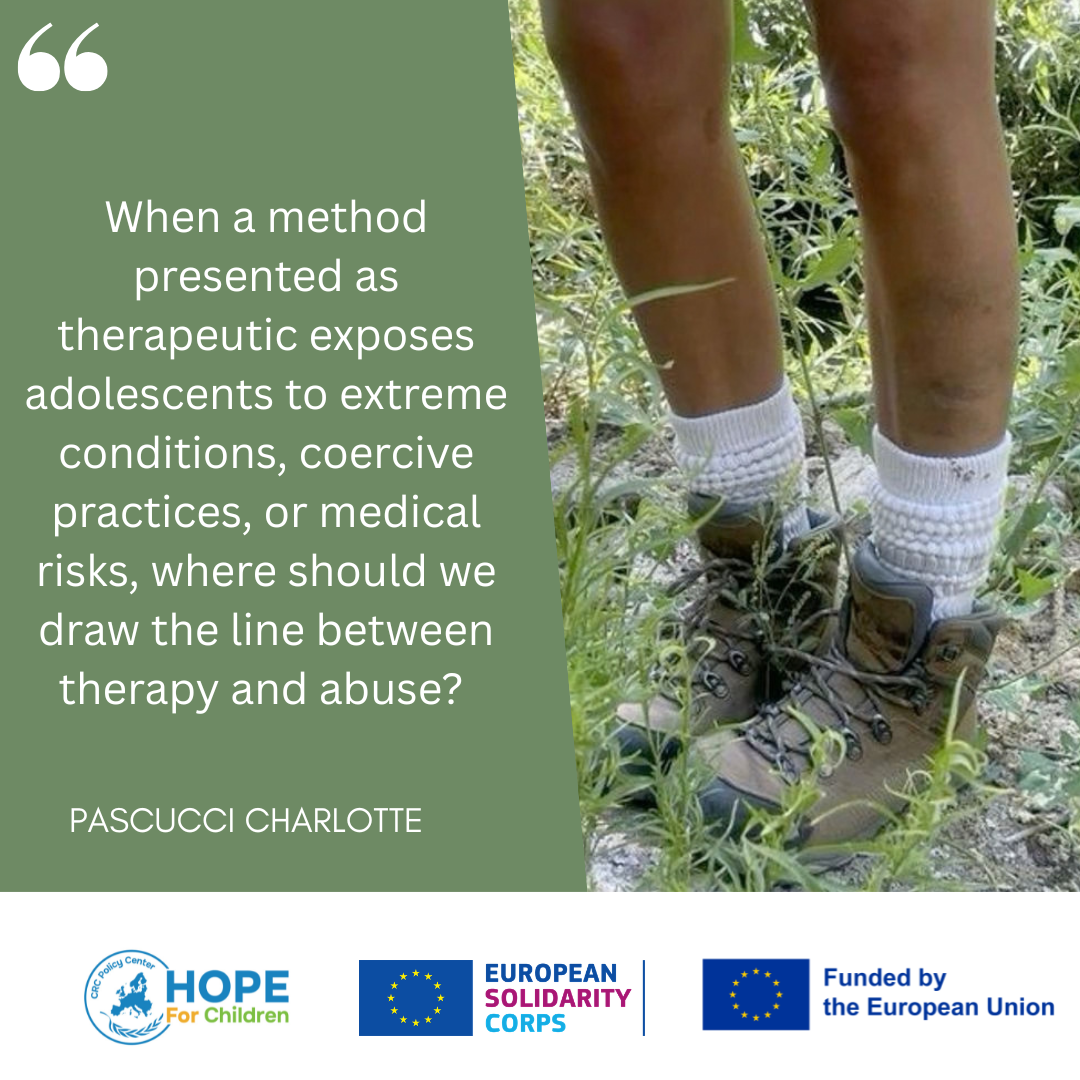
There is no single federal definition of wilderness therapy in the United States. Broadly, it can be described as a form of therapeutic support that takes place in nature, often in remote environments such as forests, mountains, or deserts. The idea behind these “therapy” programs is to combine living in nature as part of a group, physical activities, and psychotherapy to help people, particularly adolescents, to work through certain challenges. The natural setting is intended to help participants break away from their daily routines, gain perspective, and develop certain skills such as independence, self-confidence, emotional regulation, and cooperation through programs where participants may hike for several hours, go camping, cook in groups, and reflect, as described by the Anasazi Foundation. Wilderness therapy programs are offered to adolescents and young adults who are experiencing psychological or behavioral difficulties, such as depression, as well as adolescents who exhibit violent behaviour. Wilderness therapy programs exist in the U.S. as well as in Europe, although the term is different there, it is better known as “adventure therapy.” In the United States, programs typically involve spending several weeks in a wilderness area with hiking, camping, and group therapy, whereas in Europe, the experience is often less extreme, consisting of a few days or weeks of hiking, nature, adventure, and therapeutic sessions, rather than a full survival expedition. However, it is important to make a key distinction: “wilderness therapy” encompasses a wide range of practices. Some programs are genuinely therapeutic and supervised by qualified professionals, while others have been heavily criticized for their coercive methods, lack of medical supervision, or the harsh conditions imposed on participants and this article examines it. It’s worth noting that there is no comprehensive national tally of deaths related to wilderness therapy in the United States. A Government Accountability Office investigation had already documented 10 deaths in residential programs for youth between 1990 and 2004, while other deaths were reported in the years that followed. The available data do not allow the total number of victims since 1990 to be determined with certainty, as many cases are hidden or go unreported. It was through videos on social media platforms like TikTok that young people began sharing their own experiences as well as those of their peers. When a method presented as therapeutic exposes adolescents to extreme conditions, coercive practices, or medical risks, where should we draw the line between therapy and abuse?
Behind this image of reconnecting with yourself, lie significant risks, particularly in certain U.S. residential programs for adolescents. An investigation by the Government Accountability Office (GAO) documented several deaths that occurred in residential programs for young people, some of which use wilderness therapy.
Reported causes include:
- Dehydration
- Heatstroke
- Untreated medical conditions
- Use of physical restraints
- Suicide and failures of suicide prevention
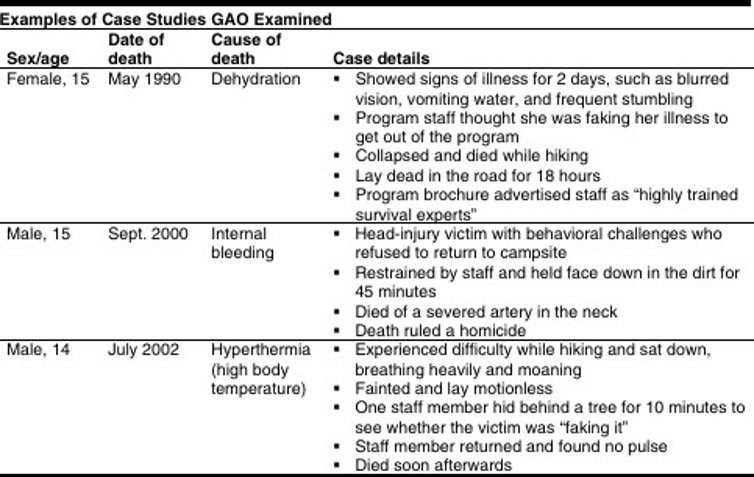
Concerns Regarding Abuse and Death in Certain Programs for Troubled Youth, 2007
In one of the cases studied in this table (second column), a 15-year-old teenager died after being held face-down on the ground for several minutes, he died of internal bleeding. His death was classified as a homicide. Some programs pose dangers that do not stem solely from the natural environment, such as heat, cold, or injuries, but can also arise from staff members, abuse, and the program’s supervision. In most cases, “internal bleeding/hyperthermia/dehydration” is listed as the medical cause of death, but this alone does not explain why the child reached that state.
By examining the decisions made by the adults in the program: Were they aware of the child’s distress? Did the child have access to water? Was medical care sought, and was it sought in time? Were the symptoms taken seriously?
- Inadequate staff training: A common finding in the cases examined by the GAO is that staff often misinterpreted signs of medical emergencies. Symptoms of dehydration, heatstroke, or illness were overlooked, as staff sometimes assumed that the adolescents were pretending to be unwell in an attempt to leave the program. This failure to recognize their medical distress had serious consequences, including deaths. In the cases examined, staff only became aware of the severity of the adolescents’ conditions when it was already too late.
- Insufficient food and water: According to the GAO, in some programs, staff gave adolescents “only an apple for breakfast, a carrot for lunch, and a bowl of beans for dinner, while requiring them to engage in intense physical activity under difficult conditions.” Food rations were the same for all the young people, regardless of their height, weight, or specific nutritional needs.
- Reckless or negligent practices: In addition to being untrained, the staff led hikes in unfamiliar terrain without conducting reconnaissance. Furthermore, in many programs, there was no “transition” period to adjust from a home environment to a much less comfortable and harsher setting. The chosen environments thus forced the teenagers to focus on themselves and forget the comforts of modern life.
- Abuse: A final concern is abuse, which takes the form of neglect and the refusal to provide victims with necessary care, water, and food. In other cases, there has also been physical and psychological abuse. The Regulatory Review, 2023
In the U.S., unfortunately, it’s not just wilderness therapy that’s well-known, but also cases of abuse and neglect at private institutions such as Elan School, which was a private therapeutic facility located in Maine, in the United States, belonging to the group: Home – National Association of Therapeutic Schools and Programs. Founded in 1970, the school primarily enrolled teenagers considered to have behavioral problems or in need of special supervision. It finally closed its doors in 2011. According to former students, the methods used at Elan School were extremely harsh, including public humiliation, isolation, physical restraint, and collective punishments. Some were also reportedly forced to participate in physical confrontations between students in an area called “The Ring.” These practices were presented by the administration as part of a rehabilitation program, but several former students have, on the contrary, described them as forms of violence and abuse. The school relied on the same system as Synanon, whose primary method involves the use of humiliation and physical violence. Ati, 2022
Why Were These Programs Able to Continue?
The question that naturally arises is: How were programs in which teenagers died or were abused able to continue operating? One important explanation was fragmented oversight. In the United States, there was no uniform federal legal definition of wilderness therapy, nor were there specific regulations governing all such programs. Responsibility rested largely with the states, whose rules varied considerably: some required licensing and oversight, while others did not regulate certain private programs. The Government Accountability Office (GAO) thus found that several programs examined were not covered by an operating license and that some licensed programs had violated the terms of their licenses. This fragmentation also allowed certain facilities to operate under different names and thereby evade certain regulatory obligations. The problem was also a lack of information: parents did not always have sufficient information to assess the safety and qualifications of a program. Finally, even when a program was officially monitored, oversight might come too late; in some cases investigated after a death, authorities discovered violations of health and safety regulations and subsequently took action against the facility. However, we should avoid portraying this situation as a complete lack of regulation: some states did have licensing, inspection, and investigation mechanisms in place, and programs were shut down following serious incidents. What was lacking was a single, transparent, and well-coordinated system under which every program offering this kind of care would meet minimum safety standards.
Parents
In some cases, the parents themselves were participants of the system. The GAO documented cases in which families had been persuaded by brochures, promises made by program officials, and the highly professional presentation of the programs. In one case, the parents of a 16-year-old had even taken out a second mortgage on their home to pay for his program; they were unaware that it had been created by former employees of another program where a teenager had died. This shows that parents may not have all the facts when making decisions about their children. The issue takes on a different dimension, however, when parents know that their child is suffering, protesting, or being subjected to dangerous practices, yet choose to continue with the program nonetheless. In such cases, it is legitimate to question their responsibility. One crucial factor must also be taken into account: teenagers are often sent to these programs precisely because their parents believe they have exhausted all other options. The GAO also notes that some programs enrolled youth whose parents forced them to participate. Ethically, this is complicated since a teen is not merely an object of parental decision-making; further, some teens were forcibly removed from their homes late at night and brought to the program. Responsibility must be examined in a chain: parents for choosing and monitoring the program, and professionals who are far more directly responsible for the safety and care of the youth, methods used, and respect for the youth.
Is wilderness therapy safer today than it was 20 or 30 years ago?
This answer is complicated because, in some programs, the answer may be yes, but data are lacking to make such a claim about the industry as a whole. Notably, the Association forExperiential Education (AEE) developed an accreditation system for adventure programs as early as 1994 and, more recently, specific standards for Outdoor Behavioral Healthcare. However, this does not mean that all wilderness therapy programs are safe. A recent incident illustrates this limitation: in 2024, Clark Harman, a 12-year-old boy, died 24 hours after arriving at the Trails Carolina program. The medical-legal investigation concluded that the cause of death was asphyxiation, and North Carolina authorities revoked the program’s license after identifying several deficiencies. NCDHHS, 2024. Safety standards have undoubtedly improved, and some programs are far better organized than they were three decades ago. However, recent incidents also show that, on many levels, existing safeguards cannot guarantee that tragedies will be prevented. Even if a program is secured in terms of its physical facilities, what about psychological and ethical security? Physical safety may involve providing shelter, food, medical care, and protection from immediate physical harm, but this does not necessarily mean that a young person feels safe or respected. Forced practices, restraint, isolation, and the use of programs against a young person’s will remain controversial issues. While these practices may sometimes be justified as necessary for protection or behaviour management, they can also undermine a young person’s autonomy, dignity, and sense of trust. Therefore, the effectiveness of wilderness therapy should not be evaluated only by whether participants are physically protected, but also by whether their psychological well-being, rights, and individual needs are respected. True safety should involve both the protection of the body and the protection of the person.